
Alg4Hyd
Integrated bio-hydrogen technology
Alg4Hyd Technology
Integrated bio-hydrogen platform
Alg4Hyd brings together biology, engineering, and energy conversion to create an integrated bio-hydrogen platform. The technology is based on microalgae that use sunlight and simple nutrients to produce hydrogen under controlled conditions, with downstream use in fuel cells and biomass valorization.
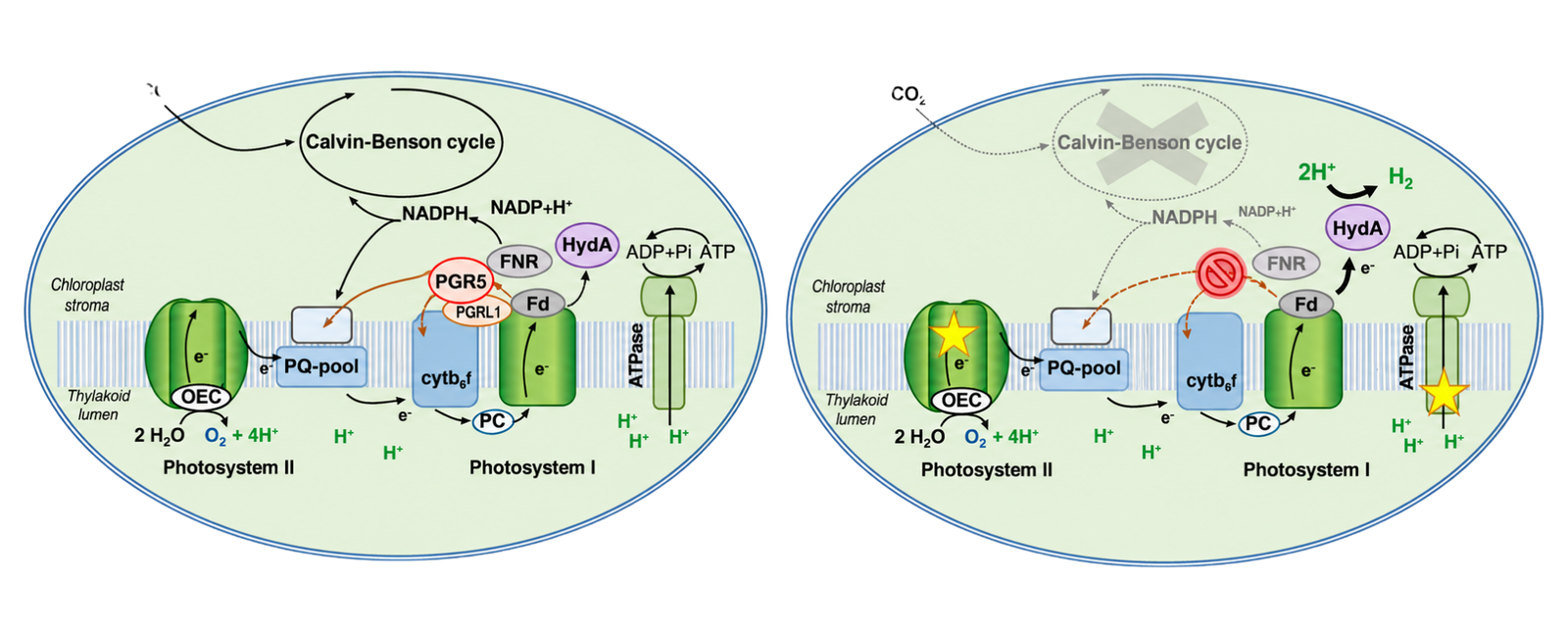
State-of-The Art
Technology
The technology of Alg4Hyd is to establish a sustainable and efficient bio-industrial bio-H₂ production system, using algae as whole-cell biocatalysts.
Microalgal strain optimization
The first technological pillar is the selection and improvement of high-performing microalgal strains. The project will screen collections of Chlamydomonas reinhardtii and Chlorella sp. to identify the best wild-type backgrounds for hydrogen production, then develop pgr5 gene-edited strains using CRISPR-Cas12a.
Photobioreactor development
The second pillar is the design and optimization of photobioreactors. Alg4Hyd will compare different laboratory-scale systems, including thin-layer and tubular/panel configurations, and then scale the best-performing setup to pilot-scale indoor and outdoor operation. The project focuses on improving light use, culture stability, and productivity while keeping the system scalable and suitable for real-world deployment.
Pilot-scale bio-hydrogen production
The project will validate the technology in pilot-scale conditions and move from TRL 3 to TRL 5. This includes testing under dynamic outdoor environments, where variations in temperature and sunlight provide a more realistic assessment of industrial performance.
PEM fuel cell integration
Alg4Hyd will explore the direct use of bio-hydrogen in low-temperature and high-temperature PEM fuel cells. This is an important step because it reduces or eliminates the need for extensive purification, storage, and transport. The project will study performance, impurity tolerance, durability, and dynamic response, with the goal of demonstrating a practical energy conversion pathway from bio-hydrogen to electricity.
Biomass valorization
The final technological element is the use of spent algal biomass as a biostimulant or fertilizer. Through metabolomic and transcriptomic analysis, the project will identify valuable compounds formed during hydrogen production and test the residual biomass in greenhouse systems, including tomato and maize cultivation.